
Remember Snapchat Planets in Order With a Simple Memory Map
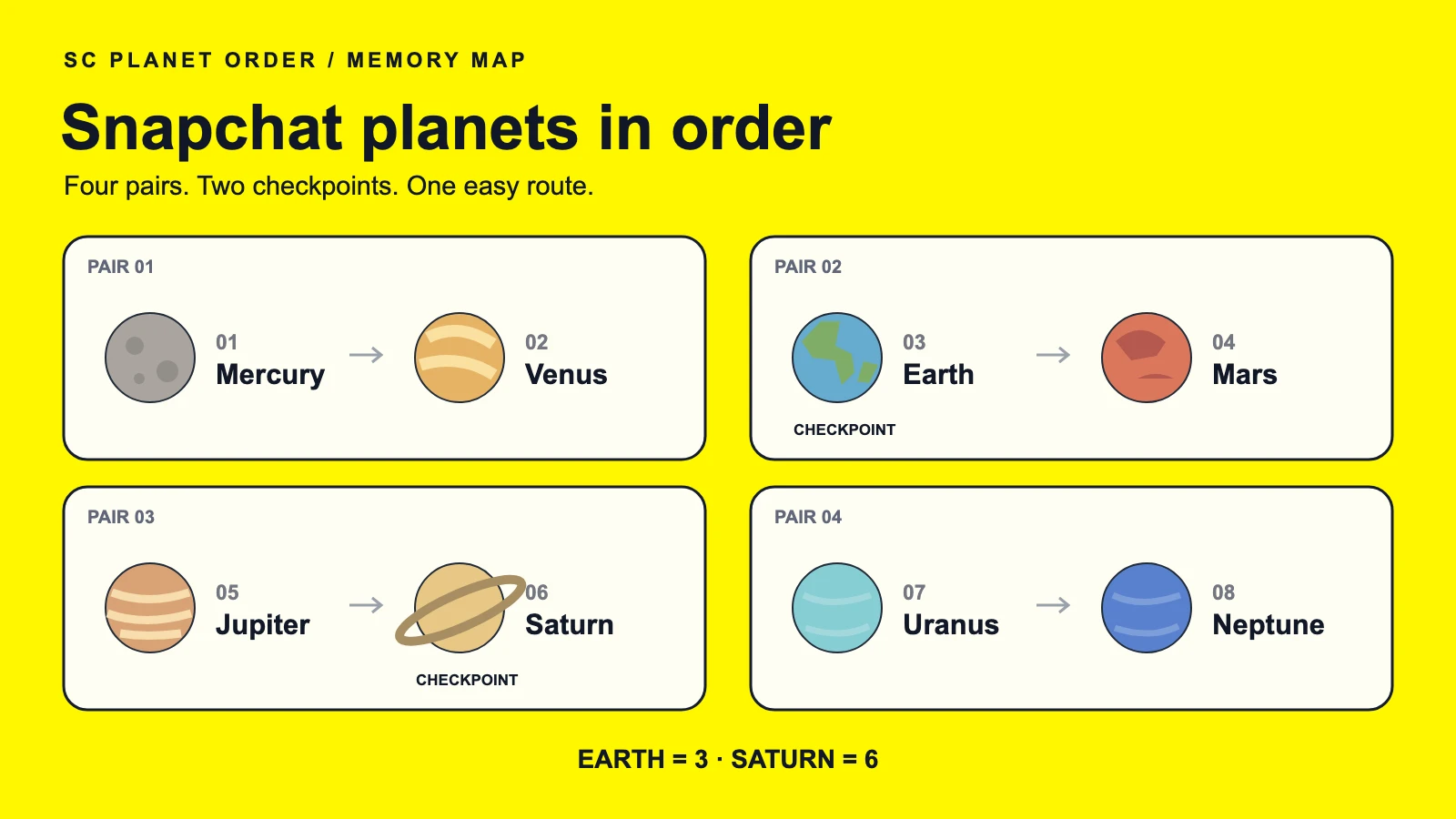
Mercury, Venus, Earth, Mars, Jupiter, Saturn, Uranus, Neptune. That is the sequence for Snapchat’s eight planets, starting with the position closest to the Sun. Earth sits at three and Saturn at six, which gives you two handy places to start if you forget a name. The awkward part is remembering what goes between them. Was Venus before Earth? Does Uranus come before Neptune? A short reference can answer those questions, but a few associations make it easier to recognize a planet when it turns up on your screen.
Four pairs are easier to keep track of
A familiar theme gives a screen some personality. The Western name of cowboyspin casino does that for a casino, while Snapchat uses planets to represent positions in a friends list. With the planets, though, recognizing the theme only gets you so far. You still have eight names to put in the right places.
Break them into pairs: Mercury–Venus, Earth–Mars, Jupiter–Saturn, Uranus–Neptune. The pause after each pair helps separate names that otherwise run together. There is also a schoolroom mnemonic you may remember: “My Very Educated Mother Just Served Us Noodles.” Its opening letters match the planets, from M through N. If that sentence feels more cumbersome than the names themselves, skip it. The four pairs are a perfectly good reference on their own.
The two Ms deserve a little attention. Mercury starts the sequence; Mars ends the first half. A list of initials alone will not tell you which M belongs where. Write out those two names the first time you make a note, even if you abbreviate everything else. Here is the small distinction to remember when the opening letters trip you up.
Mercury begins the list. Mars is fourth, immediately after Earth.
Earth gives you somewhere to start
Earth is third. From there, Venus is one place back and Mars is one place forward. Mercury fills the remaining space at the beginning. This gives you a way to answer a question about an individual planet without reciting the entire sequence. Asked about Venus, for instance, you can work back from Earth instead of trying to summon a picture of the whole solar system.
| Position | Planet | A way to remember it |
|---|---|---|
| 1 | Mercury | The first M |
| 2 | Venus | Immediately before Earth |
| 3 | Earth | Home, at number three |
| 4 | Mars | The second M, after Earth |
NASA calls these the four inner planets. That is a useful place to divide your note: one row for Mercury through Mars, another for Jupiter through Neptune. The division comes from astronomy, rather than a separate Snapchat setting. Nothing special happens to a friendship when it crosses that line on your handwritten chart.
Try filling a gap instead of rereading the table. Write “Mercury, ___, Earth, Mars” and supply the missing name. Then leave out Earth. Being able to fill either gap is a better check than simply recognizing the sequence while it is still in front of you. You can do this with a note on your phone; there is no need to keep reopening someone’s profile to practice.
Saturn marks the sixth spot
The second row starts with Jupiter. Saturn follows at six, then Uranus and Neptune finish the list. Saturn’s rings make a convenient mark for your chart: circle the number six. With that in place, Jupiter belongs on its left and the last two planets go on its right. This is a drawing for remembering the order, so a rough circle does the job.
| Position | Planet | A way to remember it |
|---|---|---|
| 5 | Jupiter | First in the second row |
| 6 | Saturn | Circle six for the rings |
| 7 | Uranus | Between Saturn and Neptune |
| 8 | Neptune | The last name |
To check all Snapchat planets in order, cover the names and keep only the numbers visible. Filling the row from memory shows exactly where you hesitate. Perhaps the first six come easily but Uranus and Neptune switch places. In that case, work on the final pair rather than starting again at Mercury every time. The exercise below takes you through one complete attempt.
- Write two rows of four numbered spaces.
- Fill in Earth at three and Saturn at six.
- Put Venus immediately before Earth.
- Add Mercury at one and Mars at four.
- Finish with Jupiter, Uranus, and Neptune in the empty spaces.
- Uncover the table and compare each name with its number.
Whose planet are you looking at
Remembering a number will not help much if you read it from the wrong person’s perspective. Snapchat’s description of the Solar System explains that the badge shows your position in the other person’s list. Keep that direction in mind when someone sends you an image with very little explanation attached.
Here is a hypothetical example. You open Alex’s Friendship Profile and see Earth. The third position refers to you in Alex’s list. It does not establish Alex’s place in yours. If Alex sends you an Earth screenshot instead, you need to know which profile Alex opened. Two nearly identical images can be answering different questions, especially after the names have been cropped away.
So “What is the order of planets on Snapchat?” sometimes needs a follow-up: which name are you trying to identify, and whose profile were you viewing? Once those details are clear, the table gives a straightforward answer. Without them, it is easy to agree on the number and still misunderstand what the screenshot means.
Earth means third. The profile you opened tells you whose list that third place belongs to.
What to keep in your reference
A search for the solar system planets on Snapchat in order can turn up crowded charts full of hearts, avatars, and labels. You may prefer something plainer. For looking up a forgotten name, the eight numbered positions are enough. Our best friends planet guide covers the wider feature; a quick reference only needs a few details.
- Mercury through Neptune, with every name written out.
- A number beside each planet.
- A line break after Mars.
- Earth and Saturn marked at three and six.
- A short reminder that the profile supplies the context.
Keep whichever version you actually find easy to read. That might be the two tables above, a phone note, or the sentence about noodles. You do not have to memorize the whole sequence to understand one badge. Look up the name, check the position, and make sure you know whose list is being shown. The next time Venus or Uranus slips your mind, you will know exactly where to look.

Amber Burnett
Amber Burnett, M.A., is a communication expert and educator with over 15 years of experience driving social media growth. She is sharing snapchat growth at scplanetorder.com. Specialising in effective communication, collaboration, and STEM education, she has a proven track record of building successful businesses across the globe. She is serving as lecturer at school of professional communication at Texas Tech University.